




Plastic Deck Blocks vs Concrete: Which Actually Holds Up?
Quick Answer for Builders and DIYers:
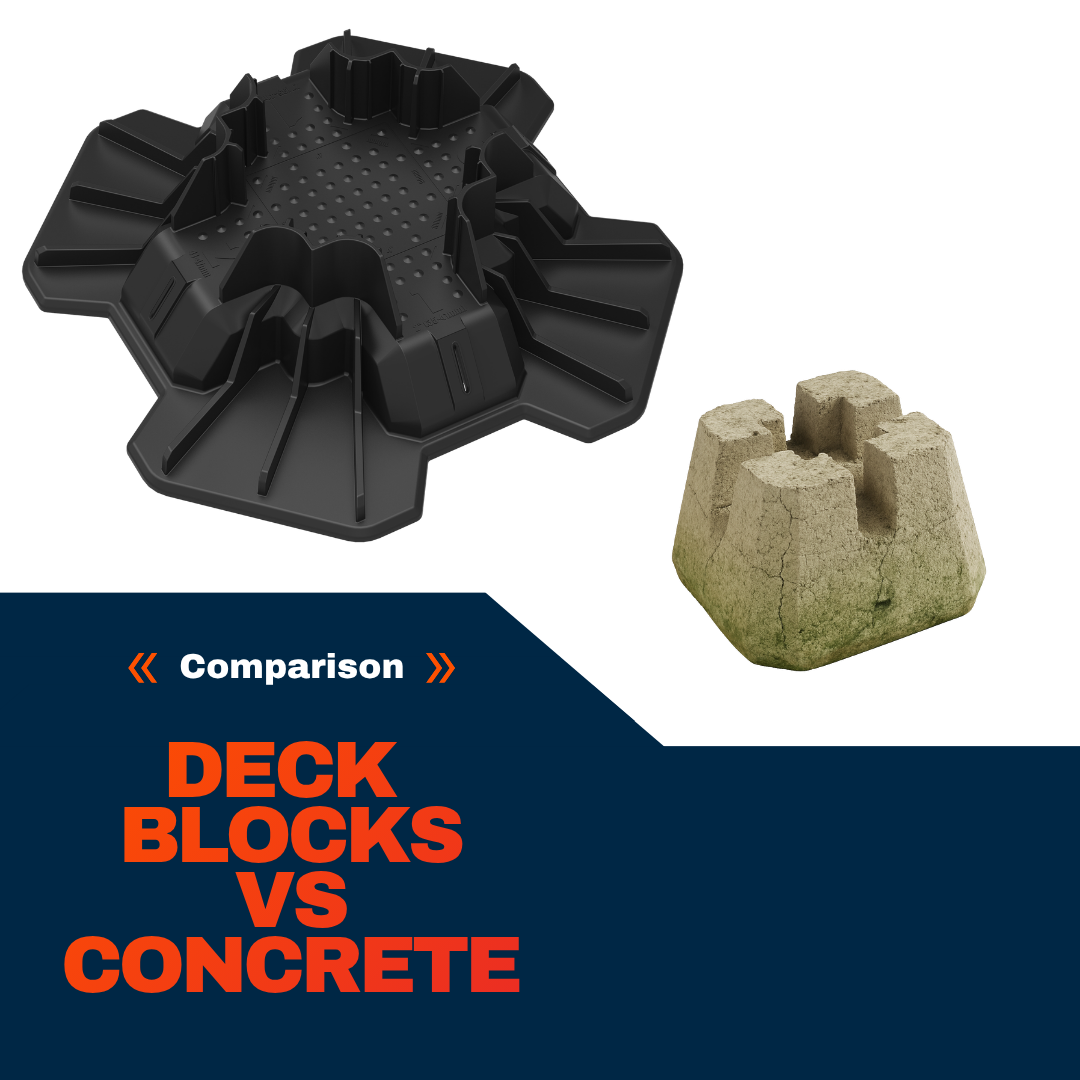
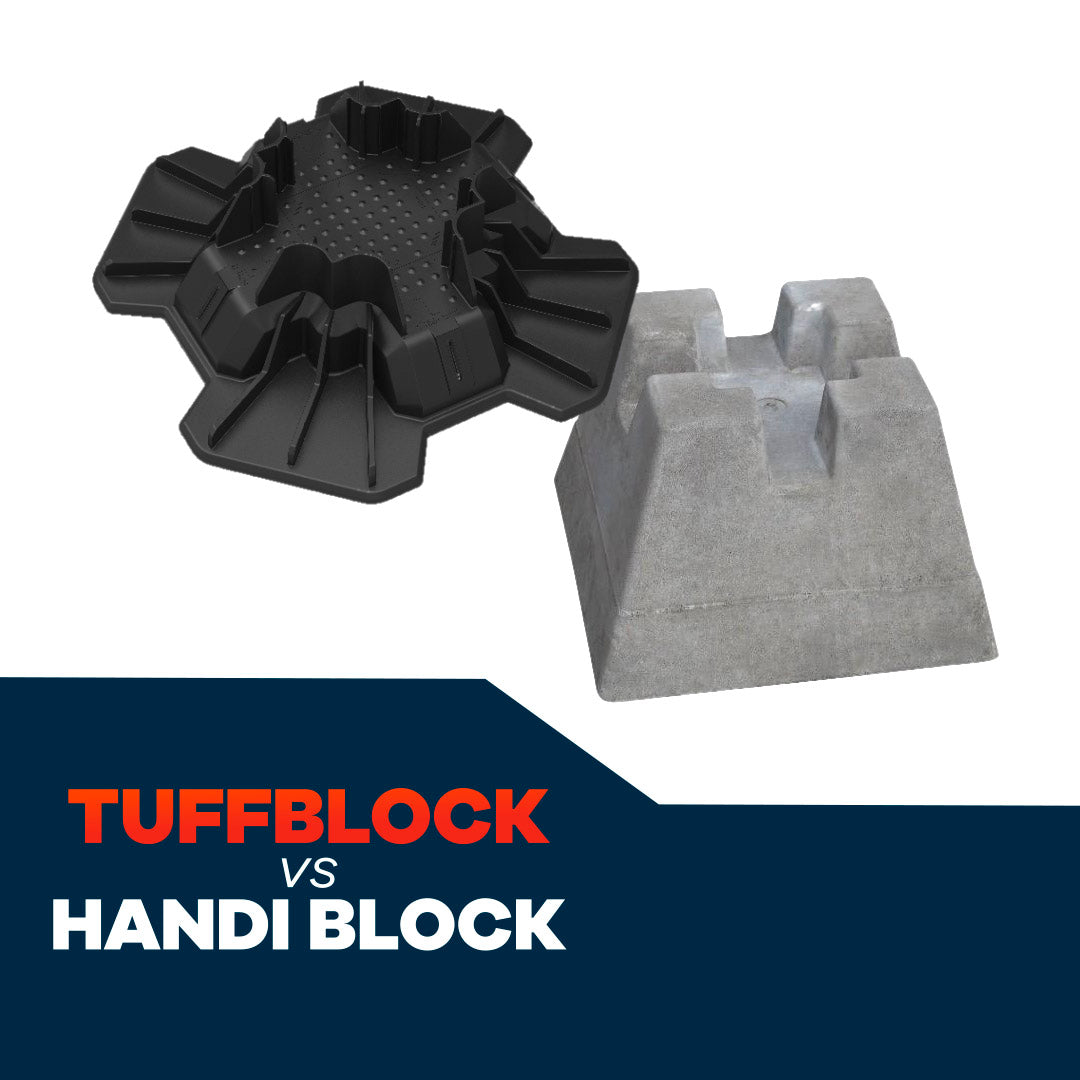
Plastic deck blocks, when made from certified structural-grade polymer, outperform concrete deck blocks on almost every practical metric. They are 27x lighter, build lower, won't crack in freeze-thaw conditions, don't absorb moisture, and come with a 25-year warranty. Concrete blocks are heavier, absorb water, crack over time, and carry no warranty or certified load rating. The comparison below covers everything you need to know before you choose.

JUMP TO WHAT YOU NEED
In this guide:
- Plastic deck blocks vs concrete: full comparison
- Where plastic deck blocks win
- Where concrete deck blocks have the edge
- Not all plastic deck blocks are equal
- What makes TuffBlock different
- What makes TuffBlock different
- Which is cheaper overall?
- Cold climates: which holds up better?
- Sloped ground: which is easier to use?
- Low-profile decks: which goes lower?
- FAQ
Plastic Deck Blocks vs Concrete
Full Comparison

| FEATURE & BENEFITS | Concrete Deck Blocks | Plastic Deck Blocks (TuffBlock) |
|---|---|---|
| Weight per block | 34–41 lbs | 1.5 lbs |
| Load rating (verified) | Unverified | 1,700 lbs |
| Break test | No published data | 11,000 lbs |
| ICC-ES certified | ✘ | ✔ |
| Lowest build height | 12"–18" minimum | 6" above grade |
| Absorbs moisture | ✔ | ✘ |
| Cracks in freeze-thaw | ✔ | ✘ |
| UV resistant | ✘ | ✔ (stablized) |
| Termite risk | Direct soil contact risk | None — keeps timber off soil |
| Adjustable on slope | Very limited | ✔ (with post extensions) |
| Fits real lumber sizes | Inconsistent fit | ✔ (3.5"×3.5", 4"×4" posts; 1½"–2" joists) |
| Warranty | ✘ | 25 years (TuffBlock) |
| Made in USA | Varies | ✔ |
| Price per block | $6–$10 | $12 (TuffBlock) |
| Free shipping | ✘(weight makes delivery costly) | ✔ |
Where Plastic Deck Blocks Win
Weight and handling
This is the most immediately obvious difference on a job site. A standard concrete deck block weighs 34–41 lbs. A TuffBlock weighs 1.5 lbs.
That is 27 times lighter.In practice this means one person can carry a full 24-pack of TuffBlocks in a single box, something that would require a pallet and mechanical handling for concrete blocks. For a 12' × 12' floating deck needing around 24 support points, a TuffBlock foundation involves handling approximately 36 lbs of material.
The equivalent concrete block setup involves handling over 900 lb, before any concrete mixing or timber framing begins.For professional builders, this directly affects how many jobs can be completed per day and what equipment is needed on site. For DIYers, it is often the difference between a project that is genuinely achievable and one that is not.
Moisture resistance
Concrete is a porous material. It absorbs moisture from soil contact, from rain, and from condensation, and transfers that moisture upward into the timber sitting on top of it. Over time this creates ideal conditions for timber decay and, in warmer climates, for termite access to structural lumber.
TuffBlock is a closed-cell polymer as it does not absorb moisture at all. It also has a ventilated underside that wicks moisture away from the timber rather than trapping it. This is one of the most significant practical differences for long-term durability, particularly in wet climates or on ground that holds moisture.
Freeze-thaw performance
Concrete absorbs water. Water expands when it freezes. This is one of the most common failure mechanisms for concrete deck blocks in cold climates, moisture penetrates the block during wet periods, then freezes and expands internally during winter, causing the block to crack from the inside out. Over several freeze-thaw cycles, blocks can deteriorate significantly.
TuffBlock absorbs no moisture and therefore has no internal water to freeze. It is specifically designed for freeze-thaw climates, the floating foundation system was originally developed in North America for exactly this environment. TuffBlock shed and deck foundations have been performing reliably in Minnesota, Michigan, Wisconsin, Colorado, and throughout Canada for years without freeze-thaw related failures.
For a deeper look at how TuffBlock handles freeze-thaw conditions, read our full guide: Frost Heave and Deck Foundations: How Floating Deck Foundations Prevent Ground Movement.
Low-profile builds
Concrete deck blocks have a fixed physical height that sets a minimum elevation for the deck surface above it. In practice, concrete blocks require a finished deck height of 12"–18" or more above grade, which means a step up from the surrounding ground that many homeowners do not want.
TuffBlock allows builds as low as 6" above grade. For homeowners who want a deck that sits close to ground level, almost like an elevated patio, this is the only deck block system that makes it genuinely possible.
Adjustability on sloped ground
Concrete deck blocks have no adjustment mechanism. On flat, perfectly level ground they are manageable. On sloped ground, which describes most residential yards, getting a concrete block foundation to a consistent level requires shimming, grinding, or stacking that is both time-consuming and aesthetically poor.
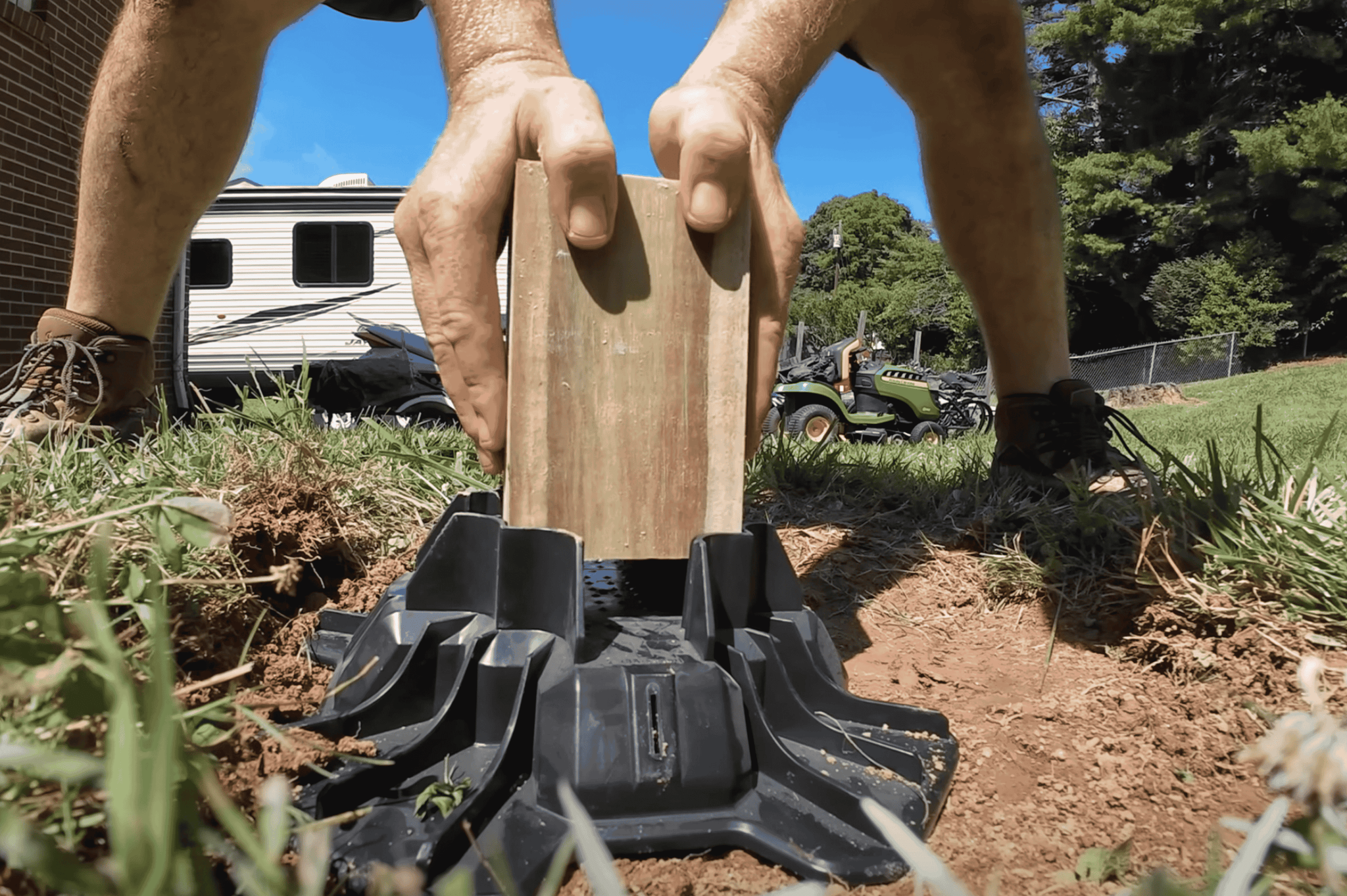
TuffBlock works with 4×4 post extensions that sit in the block saddle above the block. Post height is simply cut to the measurement needed at each support point. On a yard with a 12" slope across a 12' deck width, the low-end posts are 12" taller than the high-end posts, straightforward to measure, cut, and install. No shimming, no grinding, no improvisation.
If you're building on a slope, our full step-by-step guide covers everything you need to know, click here.
Certified load rating
Every structural element used in a building foundation should have a verified, independently assessed load rating. TuffBlock is load-rated to 1,700 lbs per block with a break test to 11,000 lbs, both independently verified as part of the ICC-ES certification process.
Standard concrete deck blocks carry no published, verified load rating. The material is known to be strong in compression, but the specific blocks available at hardware stores have not been independently assessed for their structural capacity as deck foundation elements.
Warranty
TuffBlock carries a 25-year manufacturer's warranty. Concrete deck blocks carry no warranty of any kind. Zero TuffBlock warranty claims have been made since the product launched.
Where Concrete Deck Blocks Have the Edge
Being direct matters here. There are scenarios where concrete deck blocks are a reasonable choice:
Lower upfront cost per block. A concrete deck block typically costs $6–$10 at a hardware store. TuffBlock is approximately $12 per block. On a small deck needing 8–12 blocks, this is a $30–$50 difference. On a larger build, the gap is more significant in absolute dollar terms, though the total project cost difference narrows considerably when labour time and transport are factored in.
Familiarity for experienced builders. Builders who have used concrete blocks for decades know exactly what to expect from them on flat ground. TuffBlock requires a brief adjustment in method, particularly for the post extension approach on slopes, but most experienced builders find the switch straightforward after one or two builds.
That is a genuine and complete list of scenarios where concrete holds an advantage. On every other metric weight, moisture resistance, freeze-thaw performance, build height, adjustability, load certification, and warranty, TuffBlock is the stronger product.
Not All Plastic Deck Blocks Are Equal

This is the most important section in this post for anyone who has already decided to buy plastic deck blocks.
The growth in demand for plastic deck blocks has brought a significant number of unverified products to marke, typically imported without certification, with unknown material composition and no published load data. These products look similar to certified polymer blocks and are often sold at low prices, but they are not structurally equivalent.
What to look for before you buy any plastic deck block:
Verified load rating. The product must have a published, independently verified load rating, not a claimed number without data behind it. The load rating tells you what the block can actually carry, not what the manufacturer believes it can carry. TuffBlock is1,700 lbs rated, 11,000 lbs break tested, independently verified.
ICC-ES or equivalent certification. The International Code Council Evaluation Service independently assesses building products against US building codes. An ICC-ES certified product has been assessed for code compliance, meaning it can be used in permitted builds and will satisfy inspector requirements. Most unverified plastic blocks have no certification of any kind.
UV stabilisation. Plastic degrades outdoors when exposed to UV radiation, the molecular chains break down, the material becomes brittle, and structural capacity reduces over time. UV stabilisers added during manufacturing prevent this degradation. Cheap imported blocks frequently use unstabilised plastic that will become brittle within a few seasons of outdoor use. TuffBlock uses UV-stabilised polyolefin manufactured to the highest outdoor plastic standard.
Material specification. Structural-grade closed-loop recycled polyolefin is the correct material for a load-bearing outdoor foundation block. Unknown material composition, which is what you get with most unverified imports, means no assurance of structural capacity, UV resistance, or freeze-thaw performance.
Manufacturer's warranty. A meaningful warranty (10 years or more) signals genuine confidence in long-term performance. A 25-year warranty, backed by zero claims, signals something more: a product that has been tested in the real world across 150,000+ builds and has not failed.
The test: Before buying any plastic deck block, ask for the ICC-ES report number, the verified load rating data, and the warranty document. If any of these are unavailable, the product is unverified regardless of what the packaging claims.
What Makes TuffBlock Different
TuffBlock is not simply a plastic alternative to concrete deck blocks. It is a specifically engineered structural product designed from the ground up for floating foundation applications:
Material: High-strength closed-loop recycled polyolefin with UV stabilisers built into the manufacturing process. The plastic used is sourced from recylclable material, each block contains the equivalent of 295 bottle caps, and is designed to last decades outdoors before being recycled again.
Geometry: The block's base footprint is designed to distribute load across the maximum possible surface area, reducing per-unit ground pressure. The saddle system accepts real-world lumber variation, not just theoretical nominal dimensions, which eliminates the fitting problems that plague concrete blocks when used with actual construction lumber.
Ventilation: Small raised bumps on the underside of each TuffBlock create ventilation channels that draw moisture away from the timber above, rather than trapping it at the contact point, which makes a real difference to the long-term health of your frame.
Testing: Load-rated to 1,700 lbs per block. Break-tested to 11,000 lbs. ICC-ES certified. Compliant with the 2021 and 2018 IBC and IRC, the 2020 City of Los Angeles Building Code, the 2019 California Building Code, and the 2020 Florida Building Code.
Track record: 150,000+ real builds across the USA. 4.9/5 stars from 400+ reviews. Zero warranty claims since launch.
Which Is Cheaper Overall?
The per-block price comparison is straightforward: concrete blocks cost $6–$10, TuffBlock costs approximately $12. But per-block price is not the same as total project cost.
| COST FACTOR | TUFFBLOCK | CONCRETE BLOCKS |
|---|---|---|
| Blocks (24 units) | $288 | $168–$240 |
| Shipping | Free | Costly due to weight |
| Install time saving | +50% faster | Baseline |
| Equipment needed | None | Potentially none |
| Future adjustment | Jack and reposition | Difficult, often requires shimming |
| Warranty value | 25 years | None |
The block cost difference on a 24-block build is approximately $50–$120 depending on concrete block pricing in your area. Free shipping on TuffBlock eliminates or significantly reduces that gap immediately. On builds requiring more than 12 blocks, the total difference is often minimal once shipping is accounted for.
More importantly: a 50% reduction in foundation install time has real value. For a professional builder, that is labour cost directly saved on every job. For a DIYer, that is hours of effort, and the difference between a foundation that takes half a day and one that takes most of a day.
The full picture: plastic deck blocks (TuffBlock) are competitive in total project cost and superior in every performance metric.
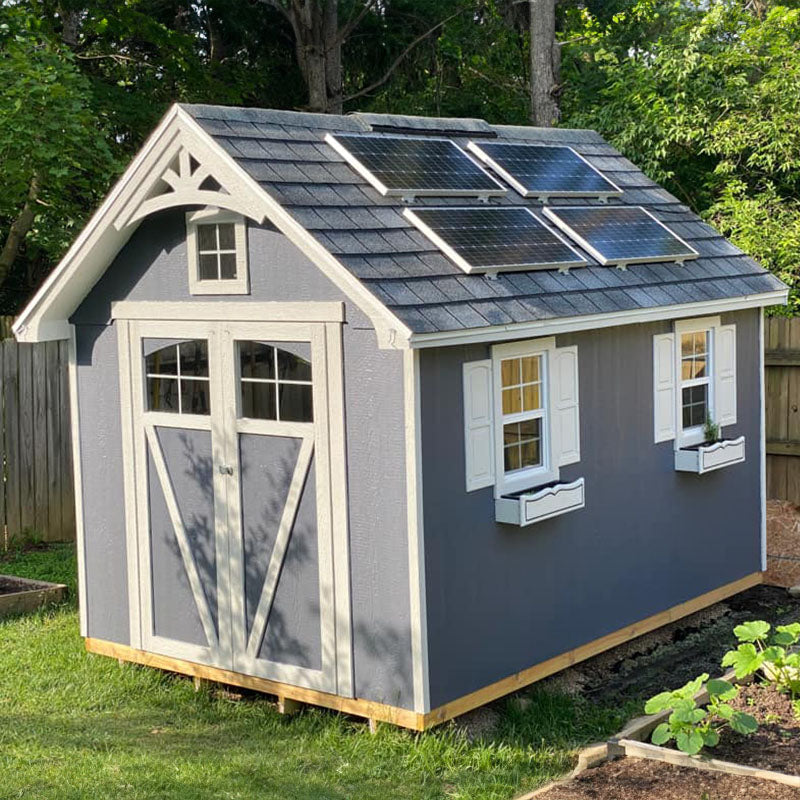
To see what that looks like in practice, read how real shed builders are using TuffBlock on the job: Shedscape and Site Built.
For your exact number, use our TuffBlock Deck Calculator.
Or read our full spacing guide: How Many Deck Blocks Do You Need?
Cold Climates: Which Holds Up Better?
Concrete deck blocks in freeze-thaw climates:
- Absorb water through their porous surface
- That water freezes and expands inside the block during winter
- The expansion causes internal cracking — often not visible on the surface initially
- Over multiple freeze-thaw cycles, blocks can crack through, crumble at the saddle, or lose structural integrity at the contact points where they carry timber loads
- Cracked blocks under a deck are difficult and disruptive to replace

TuffBlock in freeze-thaw climates:
- Does not absorb moisture, nothing to freeze inside the block
- The floating foundation system was specifically developed for freeze-thaw regions, it is designed to move slightly with seasonal ground changes rather than resist them
- UV-stabilised polymer remains flexible and structurally sound across wide temperature ranges
- Used successfully in Minnesota, Michigan, Wisconsin, Colorado, and throughout Canada without freeze-thaw related failures
If you are building in a cold climate, where frost-heave is inevitable, plastic deck blocks are not just better, they are the only sensible choice between these two options.
Sloped Ground: Which Is Easier to Use?

With concrete deck blocks on a slope:
- Blocks must be shimmed to level or the ground must be dug out and built up at each position
- Shimming with treated timber or other materials looks unprofessional and can be structurally unreliable
- Digging and re-compacting at each position adds substantial time and effort
- Once set, adjustments are difficult
With TuffBlock on a slope:
- Blocks sit on the ground wherever they land — no shimming, no adjustment to the block itself
- 4×4 post extensions in the block saddle vary in height from one support point to the next to bring the frame to level
- Post heights are simply measured from each block up to the reference level, cut, and installed
- If adjustment is needed after the fact, jack the frame, resize the post, done
Professional shed builders like Shedscape, Site Built and Squareshed working in newer residential developments, where yards are deliberately graded for drainag, switch to TuffBlock specifically because of how much faster it is on sloped sites.
Low-Profile Decks: Which Goes Lower?
If you want a ground-level floating deck that sits close to grade, the kind that looks like an elevated patio rather than a raised platform. there is no comparison.
Concrete deck blocks: The physical height of a standard concrete deck block plus the joist sitting in the saddle produces a finished deck surface approximately 12"–18" above grade. This is the inherent minimum of the system, there is no adjustment possible below this height.
TuffBlock: The finished deck surface sits approximately 6" above grade, the lowest of any deck block system available. For homeowners who want their deck close to ground level for aesthetic reasons, for accessibility, or simply because a step up is inconvenient, TuffBlock is the only option in this product category that makes it achievable.


The Smarter Alternative to Concrete Blocks.
No digging. No concrete. No curing time. Place your blocks, build your deck, done.
⭐️⭐️⭐️⭐️⭐️ Based on 500+ reviews
Shop NowRead more...
Deck Piers (Deck Blocks) or Footings? The Ultimate Guide to Building a Solid Deck Foundation
Explore the key differences between deck piers (concrete deck blocks & TuffBlock) and footings for your deck foundation. Understand when to use a pier block versus a concrete footing.


Could Plastic Replace Traditional Concrete Footings?
TuffBlocks were an excellent choice for a quick install without disturbing the root system of the large heritage trees on the property.
Ready to Build?
TuffBlock is available online with free shipping across the USA, and in-store at Lowe's nationwide.
ICC Certified
150K+ Real Builds
Rated 4.9/5 stars
25 year warranty
made in USA
Always check your local building code requirements before starting any deck project. TuffBlock is ICC-ES certified and compliant with the 2021 & 2018 IBC and IRC. Compliance may vary by local jurisdiction.