




We Had Deck Blocks Independently Tested to Destruction. Here's What Happened.
Most deck block manufacturers make claims about how strong their product is.
We decided to find out what those numbers actually look like. Not from our own testing, but from an independent accredited mechanical testing laboratory.
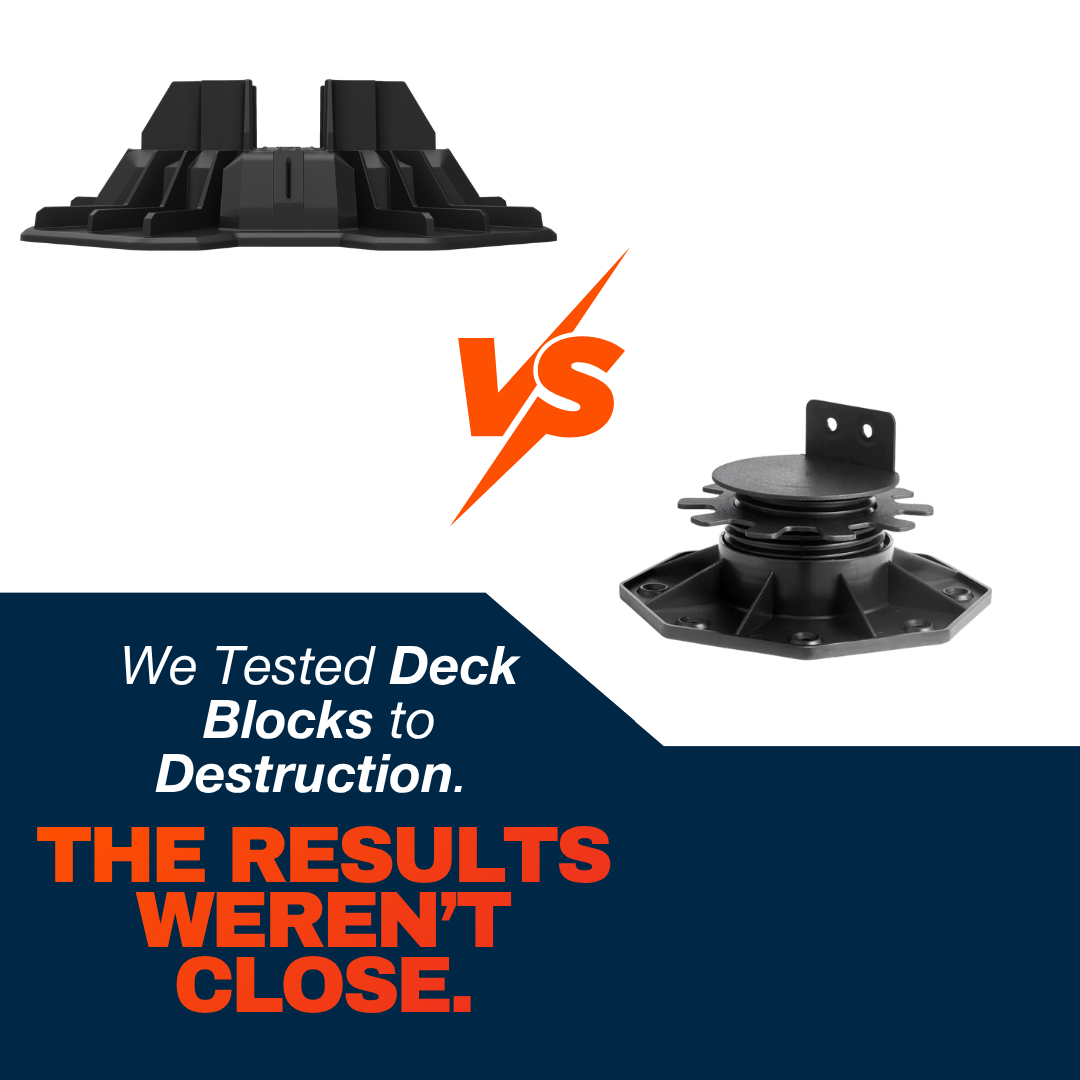
In February 2026, BuildTuff commissioned MechTest, an ISO/IEC 17025 accredited testing laboratory, to compression-test TuffBlock against the type of no-brand plastic deck block commonly sold through Amazon and similar online platforms at a fraction of the price of certified products.
The test specification was simple: load each block to failure and record the peak load. What happened was not close.

JUMP TO WHAT YOU NEED
In this guide:
- The Testing
- No-Brand: What did the test find?
- TuffBlock: What did the test find?
- The Comparison: Side by Side
- What These Numbers Mean (Real World Examples)
- Why Failure Mode Matters as Much as the Number
- What This Means When You're Buying Deck Blocks
- The Numbers Don't Lie
- FAQ
The Testing: What Was Done and Who Did It
| Laboratory | Report Number | Test Date | Accreditation | Test Method |
|---|---|---|---|---|
| MechTest — Advanced Materials Testing Services Pty Ltd | RB26-15664-01 | February 2026 | ISO/IEC 17025 accredited laboratory (Accreditation Number 20414). Authorized signatory: Thomas Wilkie. | Compression loading to failure. Each block was loaded using a crosshead compression rig, with load recorded continuously against crosshead displacement. The test continued until peak load was reached and the block failed. |
Products tested in this comparison:
- Items 03 & 04: No-brand adjustable plastic deck blocks of the type commonly available from online marketplaces without certification
- Items 10, 11 & 12: TuffBlock, tested in slot position 2 — the standard position used in residential deck and shed foundation builds

The No-Brand Import: What the Test Found
Items 03 and 04 are octagonal adjustable plastic deck block, the style sold across online marketplaces, frequently appearing in search results alongside certified products at a significantly lower price point and without published load ratings or third-party certification.

Figure 1: MechTest Photo of Item 03 - Pre test

Figure 2: MechTest Photo of Item 04 - Pre test
TEST RESULTS
| Item | Peak Load (lbs) | Recorded Failure Mode |
|---|---|---|
| Item 03 | 461 lbs | Threads skipped at full extension |
| Item 04 | 465 lbs | Threads skipped at full extension |
Average: 463 lbs

Figure 3: Load graph for items 03 & 04 showing multiple peaks and drops
The recorded failure point, threads skipping, is where the block completely loses structural capacity. But the load graph tells a more nuanced story.
The graph shows a pattern of multiple peaks and partial drops before the final recorded failure. What this indicates is that the block was not performing cleanly up to its peak load, it was experiencing partial failures and brief recoveries as different sections of thread began to give way before the final, complete thread skip was recorded. In the test video, this is visible as the block beginning to compress and partially collapse well before the thread skip is recorded as the official failure point.
In other words: the recorded peak of 463 lbs may actually overstate the load at which these blocks began to lose structural integrity. The graph shows the threaded mechanism beginning to experience partial deformation prior to the recorded peak failure point. While the recorded peak load was approximately 463 lbs, the graph indicates instability occurring before complete thread failure.
Figure 4: MechTest Item 03 - Failure
Figure 5: MechTest Item 04 - Failure
The failure mode itself, thread stripping, is the most important detail. Thread stripping is sudden and complete. There is no progressive deformation, no visible warning, no gradual settling. The block rapidly loses structural support once the threads fail. In a deck or shed foundation context, that means a support point disappearing without warning underneath a structure.
TuffBlock: What the Test Found
Items 10, 11 and 12 are standard TuffBlock units — tested in the slot position that represents a typical joist-direct deck foundation configuration.

Figure 6: MechTest Photo of Item 10 - Pre test

Figure : MechTest Photo of Item 11 - Pre test

Figure 8: MechTest Photo of Item 12 - Pre test
TEST RESULTS:
| Item | Peak Load (lbs) | Recorded Failure Mode |
|---|---|---|
| Item 10 | 9,657 lbs | Splitting at slot under block |
| Item 11 | 8,620 lbs | Splitting at slot under block |
| Item 12 | 9,414 lbs | Splitting at slot under block |
Average: 9,230 lbs

Figure 9: Load graph for items 10, 11 & 12 showing multiple peaks and drops
The load graph is a study in contrast to the import results. TuffBlock sustained a smooth, continuously increasing load before reaching peak, a clean compression curve without the partial failures and recoveries visible in the import graph. The block absorbed load progressively and consistently across all three samples, with very little variation between them.
When TuffBlock did fail, it failed by splitting at the slot position under the block, a failure mode involving visible material deformation before complete structural loss. This is a progressive failure, not a sudden one.
Figure 10: MechTest Photo of Item 10 - At point of failure
Figure 11: MechTest Photo of Item 11 - At point of failure
Figure 12: MechTest Photo of Item 12 - At point of failure
The Comparison: Side by Side
TEST RESULTS
| Observation | No-Brand Import (Items 03 & 04) | TuffBlock (Items 10, 11 & 12) |
|---|---|---|
| Average peak load | 463 lbs | 9,230 lbs |
| Load curve | Multiple peaks and partial drops | Smooth, sustained, consistent |
| Failure mode | Sudden — threads strip completely | Progressive — splitting at slot |
| Warning before failure | None, sudden collapse | Visible deformation before failure |
| Published load rating | None | 1,700 lbs rated |
| ICC-ES certified | No | Yes |
| Warranty | None | 25 Years |
| Independent test data | None Published | This report — RB26-15664-01 |
TuffBlock achieved approximately 20× higher peak compression load in this test.
What These Numbers Mean in Real Terms
Load ratings are more meaningful when translated into something you can picture.
TuffBlock at 9,230 lbs average peak load:
- Average family sedan (approx. 3,300 lbs): TuffBlock reaches break load at the equivalent of nearly 3 cars stacked on a single block
- Fully loaded Ford F-150 (approx. 6,000 lbs loaded): TuffBlock exceeds the equivalent of 1.5 fully loaded trucks per block
- Average American adult (approx. 180 lbs): TuffBlock reaches break load at the equivalent of 51 people standing on one block
- Safety factor vs rated load: TuffBlock is rated at 1,700 lbs. The average break load across these three samples is 9,230 lbs. That is a 5.4× safety factor built into every block — between what it is rated for and what it actually takes to break it
No-brand import at 463 lbs average peak load:
- Average American adult (approx. 180 lbs): The tested blocks reach their recorded failure point at approximately the weight of 2.6 adults standing on one block
- A fully fueled riding lawnmower (approx. 500–600 lbs): The tested imports fail below the weight of a standard riding mower
- vs TuffBlock's rated load: TuffBlock's rated load of 1,700 lbs is already 3.7× higher than the peak load these blocks could sustain before failing — meaning TuffBlock's rating alone exceeds what these imports could carry to destruction
And as noted above: given the partial failures visible in the load graph before the recorded thread skip, the point at which these blocks begin to lose structural integrity under real-world sustained loading may be lower still than the 463 lb headline figure.
Why Failure Mode Matters as Much as the Number
The peak load is the headline. But how a block fails is equally important, perhaps more so, for understanding what it means in practice.
Thread stripping (no-brand import): The block fails when the adjustment threads that hold it at its set height strip away under load. This is a sudden, complete failure — the block goes from carrying load to carrying nothing without progressive warning. In a deck or shed foundation, this means a support point collapses instantaneously. There is no creaking, no visible sagging, no early indication that anything is wrong.
Splitting at slot (TuffBlock): TuffBlock fails by splitting at the slot position in the block's body, a failure mode involving sustained, progressive compression before reaching peak load. If TuffBlock were somehow loaded far beyond any real-world scenario, the failure would involve visible material deformation long before complete structural loss. That distinction matters.
There is also a practical point about what the load graph shape tells you. TuffBlock's smooth, consistent curve across all three samples indicates a homogeneous, engineered material performing predictably. The import's jagged, multi-peak curve indicates a mechanical connection, the adjustment thread, experiencing sequential partial failures under load. A foundation block that relies on a threaded mechanical connection for its structural capacity is, by design, more vulnerable to sudden failure than one made from solid structural polymer.
What This Means When You're Buying Deck Blocks
If you are comparing deck blocks by price, this test data suggests you are not comparing two products at different price points. You are comparing two products with fundamentally different structural capacities, where the gap between them is a factor of 20.
A foundation block that fails at 463 lbs, potentially less under sustained loading, is not a bargain. It is a structural risk that happens to look like one.
Before buying any plastic deck block, check three things:
- Published, independently verified load rating. TuffBlock is rated at 1,700 lbs and independently assessed through ICC-ES certification. The compression test data you have just read further supports that rating. No-brand imports typically carry no published load rating with verification data behind it.
- Certification. TuffBlock is ICC-ES certified and compliant with the 2021 and 2018 International Building Code and International Residential Code. ICC-ES certification is widely recognised across jurisdictions using the International Building Code and International Residential Code. Unverified imports carry no equivalent certification.
- Failure mode. Ask how the product fails, not just when. A product that fails suddenly and without warning is a different category of risk to one that fails progressively. The test videos and graphs in this post show that difference clearly.
The Numbers Don't Lie
TuffBlock has always been described as load-rated to 1,700 lbs and break-tested to 11,000 lbs. This independent test report, conducted by an ISO/IEC 17025 accredited laborator, confirms that structural performance with documented, replicable data.
The no-brand imports tested in the same laboratory, under the same conditions, in the same test rig, failed at approximately 1/20th of TuffBlock's average peak load. They failed at loads substantially lower than TuffBlock’s independently verified rating.This is not a marketing claim. It is a test result. The full report is available to download below.
Testing conducted by MechTest (Advanced Materials Testing Services Pty Ltd), Report RB26-15664-01, February 2026. ISO/IEC 17025 accredited, Accreditation Number 20414. Test specification: load to failure. Results are for the specific samples tested. BuildTuff commissioned this testing. The full report is available to download and should be read in its entirety.
Free Shipping Across the USA


Independently Tested to Destruction.
No assumptions. No marketing fluff.
Independent laboratory compression testing showed TuffBlock reaching an average peak load of 9,230 lbs, while tested no-brand imports failed at 463 lbs.
⭐️⭐️⭐️⭐️⭐️ Based on 500+ reviews
Shop NowShop TuffBlock with free shipping across the USA
Read more...
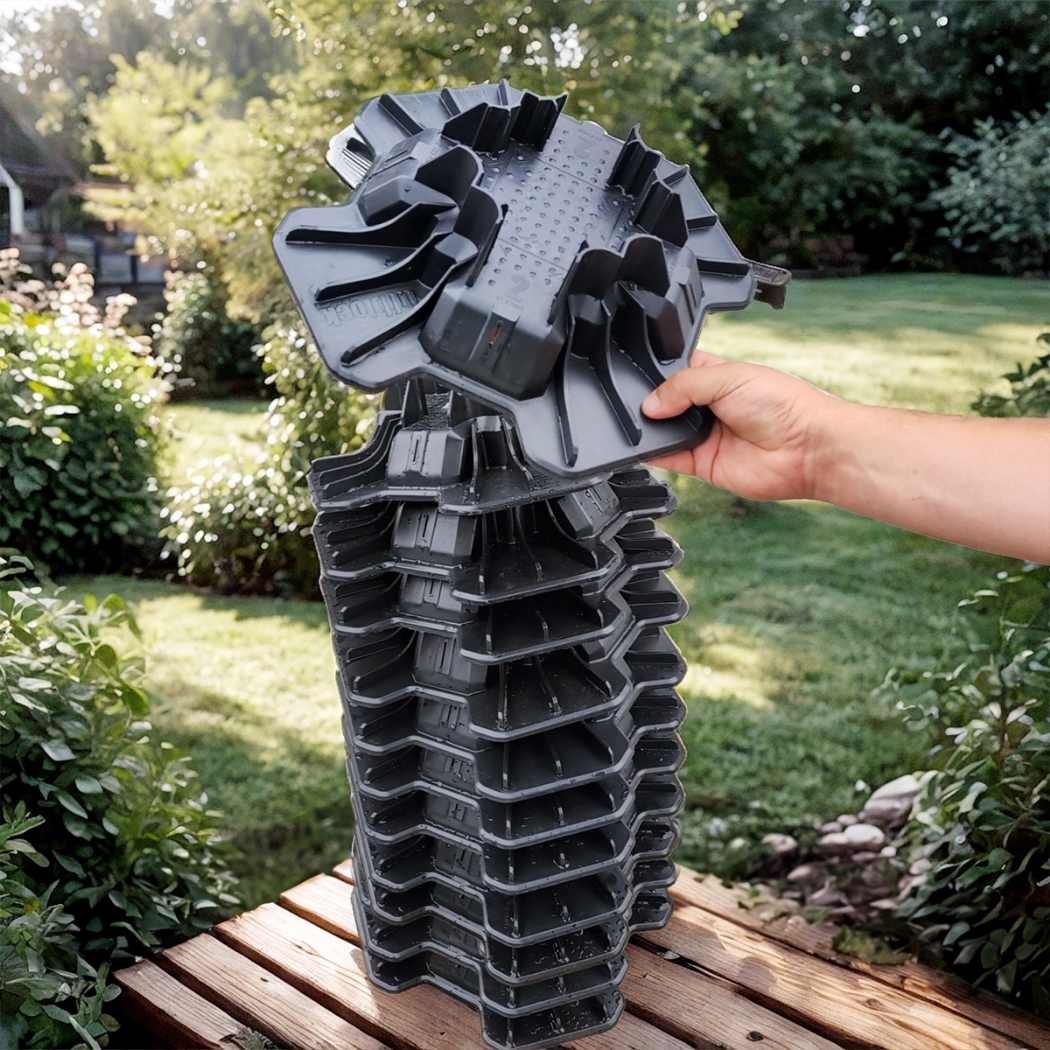
We Had Deck Blocks Independently Tested to Destruction. Here's What Happened.
We independently tested TuffBlock against traditional concrete deck blocks to see how they compare under real-world load conditions. Here’s what the results revealed about strength, durability and long-term performance.

Ready to Build?
TuffBlock is available online with free shipping across the USA, and in-store at Lowe's nationwide.
ICC Certified
150K+ Real Builds
Rated 4.9/5 stars
25 year warranty
made in USA
Always check your local building code requirements before starting any deck project. TuffBlock is ICC-ES certified and compliant with the 2021 & 2018 IBC and IRC. Compliance may vary by local jurisdiction.