




5 Shed Design Ideas That Actually Work for Any Backyard
Sheds have come a long way from the rusted corrugated box at the back of the yard.
Today's shed can be a proper backyard office, a gym, a workshop, a she-shed retreat, or a beautifully designed garden studio that adds real value to your property. The trick is matching the style to how you actually want to use the space and making sure the foundation underneath it is right for the ground you're building on.
Here are five shed styles worth knowing about, what they work best for, and the design details that separate a great shed from a forgettable one.

JUMP TO WHAT YOU NEED
In this guide:
- Gable Shed
- Lean-To Shed
- Modern Style Shed
- Lofted Shed
- Garage Shed
- Getting the foundation right for your shed style
- How many tuffblocks do you need for your shed?
- FAQ

1. Gable Roof Shed — The Classic That Never Goes Out of Style
The gable shed is the silhouette most people picture when they hear the word "shed", a peaked roof, symmetrical walls, and a traditional look that suits almost any backyard style. There's a reason it's been the most popular shed design for decades: it works.
Best for:
- Garden tools and lawn equipment
- Bikes, kayaks, and outdoor gear
- General household overflow storage
- Pool and garden equipment
- Outdoor furniture storage over winter
What makes a gable shed great: The peaked roof creates more usable interior height than a flat-roofed design, which matters when you're storing tall equipment or want shelving up the walls. Wide double doors at the front make it easy to roll in a mower or bring out a large item without wrestling it through a narrow opening.
Design ideas worth considering:
- Match the cladding and colour to your house for a cohesive look — a shed that feels like part of the property rather than an afterthought
- Add a small skillion awning over the door for weather protection and a more finished appearance
- Raised garden beds or planter boxes along the exterior walls soften the structure and help it blend into the garden
- A simple paved or gravel path from the back door to the shed makes it genuinely more useful day-to-day
Foundation note: Gable sheds suit a timber floor frame on TuffBlock deck blocks, fast to install, keeps the floor timber off the ground, and handles both flat and sloped yards cleanly. A decorative stone border around the perimeter improves drainage and gives the shed a more intentional, finished look from the outside.

2. Lean-To Shed — The Best Solution for Narrow Spaces
If you have a narrow side yard, a fence line with dead space, or an area beside the house or garage that's not being used, a lean-to shed is almost always the answer. It attaches to or sits against an existing structure, uses a single-slope roof that sheds water away from the wall, and takes up a fraction of the width of a freestanding shed.
Best for:
- Side yards and fence lines
- Firewood storage
- Bin and recycling storage
- Pool and garden equipment
- Bike and scooter storage
- Tools that need to be close to the house
What makes a lean-to shed great: The compact footprint. A lean-to can fit in a space that would be completely unusable for any other structure, a 4ft-wide side passage, a strip beside the garage, a section of fence line. And because it leans against an existing wall or structure, construction is simpler and materials cost less.
Design ideas worth considering:
- Horizontal timber or composite cladding gives a lean-to a modern, intentional look rather than a makeshift one
- Slimline sliding or bi-fold doors keep the footprint as narrow as possible while still giving proper access
- A darker paint colour — charcoal, deep olive, or navy — makes the shed feel designed rather than utilitarian
- Ventilation strips at the top of the wall or a small louvred section prevent moisture build-up, especially important for firewood storage
Foundation note: Lean-to sheds in tight side yards are often the hardest to access with heavy materials. TuffBlock is particularly useful here, each block weighs 1.5 lbs and can be carried in one hand, which matters when you're working in a space that's 4ft wide. No concrete mixing, no heavy blocks to manoeuvre through a narrow gate.

3. Modern Studio Shed — When You Need More Than Storage
This is the shed category that has grown most rapidly in recent years, driven by people wanting dedicated space for work, hobbies, and creative pursuits that simply cannot share the house. A studio shed is designed to feel like a proper roo, not a storage space with a chair in it.
Best for:
- Backyard offices and home studios
- Art rooms and craft spaces
- Home gyms and yoga studios
- Music rooms and podcast studios
- Hobby spaces — modelling, woodworking, sewing
- Guest retreats
What makes a studio shed great: The design details that make it feel like habitable space, large windows for natural light, glass or french doors, proper insulation, and a flat or skillion roof profile that gives the structure a contemporary rather than agricultural feel. The best studio sheds have a visual connection to the rest of the backyard that makes them feel intentional rather than incidental.
Design ideas worth considering:
- A small deck or landing at the entry, even 4ft × 6ft, transforms the experience of approaching and entering the shed
- A pergola or shade sail over the entry or deck creates outdoor space that extends the usable area without adding to the building's footprint
- A stepping stone or gravel path from the house to the shed makes the commute feel deliberate, which matters more than you'd think when it's raining
- Sliding glass doors rather than hinged ones give a much wider opening and connect the interior to any outdoor space in front of the shed
- External blinds or screens on large windows prevent solar heat gain in summer without sacrificing light on overcast days
Foundation note: Studio sheds with finished flooring, level thresholds for glass doors, and large window openings demand a perfectly level foundation. Any settlement or unevenness that would be unnoticeable under a garden shed becomes immediately obvious in a studio. TuffBlock's adjustable post system handles sloped ground precisely, you can level to within 1/16", and if any adjustment is needed after the build, jacking and re-levelling is straightforward without disrupting the structure above.

4. Lofted Storage Shed — Maximum Storage, Minimum Footprint
The lofted shed solves the most common shed problem: running out of space without having room to build bigger. By adding a loft level inside the shed, you effectively double the storage capacity of the structure without increasing its footprint at all.
Best for:
- Seasonal storage — Christmas, camping, holiday gear
- Archive boxes and document storage
- Overflow from the house — furniture, appliances, memorabilia
- Infrequently used tools and equipment
- Sports gear by season
What makes a lofted shed great: The vertical space that most standard sheds waste. A standard 8ft wall height with a loft floor installed at 5ft gives you usable storage above and full-height space below for equipment, workbenches, and larger items. A loft is also one of the most cost-effective ways to add storage, the additional structural cost of a loft floor is relatively modest compared to the storage space it creates.
Design ideas worth considering:
- Fixed timber ladder rather than a portable one, it's safer, takes up less floor space when not in use, and looks more intentional
- Roof windows or skylights in the loft area bring in natural light and make the upper level feel usable rather than just a dark box
- Deep shelving along the loft walls makes the most of the angled ceiling space near the eaves
- A half-door or hatch at the loft level makes it easier to load large seasonal items rather than carrying everything up a ladder
Foundation note: Lofted sheds carry more weight than a standard storage shed, the loft floor, everything stored on it, and the additional structural timber all add up. A TuffBlock foundation handles this well: each block supports up to 1,700 lbs, and the bearer method used for most shed bases distributes load across multiple support points. For a heavier lofted shed, slightly reducing the bearer span (adding an extra TuffBlock along each bearer) increases rigidity and reduces any flex in the floor underfoot.

5. Garage Shed — When You Need Serious Capacity
A garage shed sits at the larger end of the backyard structure spectrum, think roller doors, vehicle access, serious workshop space, or storage for equipment that simply won't fit anywhere else. These are proper buildings, not garden sheds, and they need to be planned accordingly.
Best for:
- Car restoration and automotive work
- Motorbikes, ATVs, and golf carts
- Ride-on mowers and farm equipment
- Serious woodworking or fabrication workshops
- Boat and trailer storage
- Commercial or trade equipment
What makes a garage shed great: Proper access and internal organisation. A garage shed that's just a big empty box quickly becomes a big cluttered box. The best ones are designed with specific storage zones, wall-mounted tool storage, clear floor areas for vehicles, workbench space along one or two walls, and enough overhead clearance for the tallest item being stored.
Design ideas worth considering:
- Double roller doors rather than a single wide one — they're easier to operate manually and allow independent access to each bay
- A personnel door on the side wall lets you enter and exit without opening the roller doors — essential in bad weather
- Skylights or translucent roof panels keep a large shed usable in daylight without artificial lighting
- Epoxy or painted concrete flooring in the vehicle area is significantly easier to keep clean than bare concrete
- A dedicated workshop zone at one end, separated visually from the vehicle storage area with a workbench and wall storage, makes the space more functional for both purposes
Foundation note: Garage sheds sit in a different category from timber-floor shed builds, most are built on a concrete slab to handle vehicle weight and the turning forces of rolling loads. However, a TuffBlock foundation works well for garage sheds with timber floors used for workshop and equipment storage (not vehicle access). For vehicle-access sheds, a concrete apron at the entry, combined with TuffBlocks supporting the interior timber floor, is a practical hybrid approach.
Always check with your local building department before starting any deck project.
Getting the Foundation Right for Your Shed Style
The five shed types above place different demands on whatever is underneath them, and getting the foundation right from the start is the single most important thing you can do for the long-term performance of any shed.
Timber floor sheds (gable, lean-to, studio, lofted) work best on a TuffBlock floating foundation. The blocks sit on compacted gravel at each support point, bearers run across the short dimension of the shed, and floor joists sit on top. The result is a level, well-ventilated floor frame that keeps timber off the soil — which matters for both rot resistance and termite protection. TuffBlock's adjustable post system means slope is handled easily, and the lightweight blocks (1.5 lbs each) make installation fast even in tight-access situations.
Studio sheds with finished flooring and glass doors need a particularly precise level. TuffBlock's post extension system allows levelling to within 1/16", which is far more precise than shimming concrete blocks.
Garage and vehicle sheds typically need a concrete slab for the vehicle access area. For the workshop or storage sections with a timber floor, TuffBlock works well and is significantly faster and cheaper than extending the concrete slab.
On sloped ground. Which applies to most residential yards — TuffBlock handles up to 12"–18" of slope across a shed footprint without difficulty. The blocks sit wherever they land on the ground; 4×4 posts above each block vary in height to bring the frame to a consistent level. No shimming, no cutting into the slope, no retaining walls required for most residential shed sites.
For a full breakdown of how many TuffBlocks you need for your shed size and how the foundation goes together, read the Shed Foundation with Deck Blocks guide and the step-by-step Pro Tips for Levelling a Shed Base.
How many TuffBlocks do you need for your shed?
Enter your shed length and width in feet to estimate required TuffBlocks and recommended pack quantities.
✔ Based on 16" on-center spacing
✔ Designed for shed foundations
✔ 150,000+ real builds
✔ No email required
Or use our shed block spacing chart below to estimate how many TuffBlocks you need based on common shed and deck foundation sizes.
| Deck Length (feet) | Deck Width (feet) | Deck Area Calculator (sq feet) | Estimated TuffBlocks |
|---|---|---|---|
| 8 | 12 | 96 | 24 |
| 20 | 10 | 200 | 42 |
| 20 | 12 | 240 | 42 |
| 30 | 10 | 300 | 60 |
| 20 | 16 | 320 | 56 |
| 35 | 10 | 350 | 72 |
The Shed That Works Is the One You Actually Build
The five shed types above place different demands on whatever is underneath them — and getting the foundation right from the start is the single most important thing you can do for the long-term performance of any shed.
Timber floor sheds (gable, lean-to, studio, lofted) work best on a TuffBlock floating foundation. The blocks sit on compacted gravel at each support point, bearers run across the short dimension of the shed, and floor joists sit on top. The result is a level, well-ventilated floor frame that keeps timber off the soil — which matters for both rot resistance and termite protection. TuffBlock's adjustable post system means slope is handled easily, and the lightweight blocks (1.5 lbs each) make installation fast even in tight-access situations.
Studio sheds with finished flooring and glass doors need a particularly precise level. TuffBlock's post extension system allows levelling to within 1/16", which is far more precise than shimming concrete blocks.
Garage and vehicle sheds typically need a concrete slab for the vehicle access area. For the workshop or storage sections with a timber floor, TuffBlock works well and is significantly faster and cheaper than extending the concrete slab.
On sloped ground. Which applies to most residential yards — TuffBlock handles up to 12"–18" of slope across a shed footprint without difficulty. The blocks sit wherever they land on the ground; 4×4 posts above each block vary in height to bring the frame to a consistent level. No shimming, no cutting into the slope, no retaining walls required for most residential shed sites.
For a full breakdown of how many TuffBlocks you need for your shed size and how the foundation goes together, read the Shed Foundation with Deck Blocks guide and the step-by-step Pro Tips for Levelling a Shed Base.
The best shed design is the one that suits your yard, your storage needs, and the way you genuinely plan to use the space. A studio shed that's too ambitious to build this season does less for you than a well-built gable shed you can finish in a weekend.
Whatever style you choose, the foundation is where the project either succeeds or creates problems for years to come. A level, well-drained, properly supported base means a shed that stays level, a floor that doesn't flex, and a structure that performs for decades without intervention.


Build your shed the smarter way.
No digging. No concrete. No waiting for permits or curing time. Just a proven foundation system that handles slopes, soft ground, and tight-access yards, where traditional concrete footings fail.
⭐️⭐️⭐️⭐️⭐️ Based on 500+ reviews
ICC Certified
150K+ Real Builds
Rated 4.9/5 stars
25 year warranty
made in USA
Read more...


5 Shed Design Ideas That Actually Work for Any Backyard
From classic gable sheds to backyard studio offices — 5 shed design ideas with practical tips on layouts, features, and the right foundation for each style.
Can I Use Deck Pier Blocks Instead of Footings?
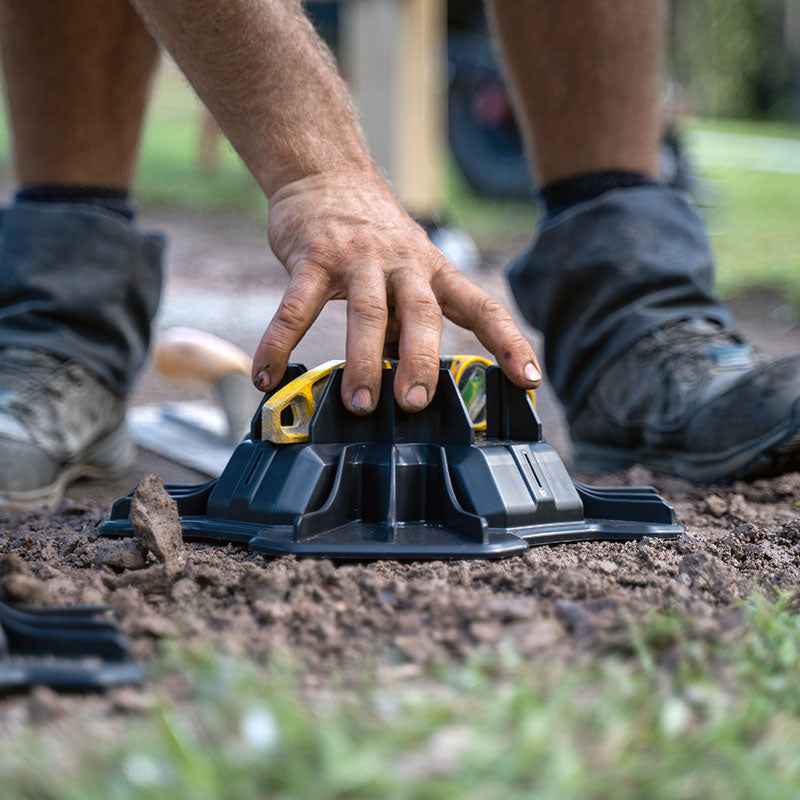
A deck pier block is in many ways just a simplified version of a “precast foundation”, a foundation type recognised by building codes.
