




Shed Foundation with Deck Blocks: Everything You Need to Know
Quick Answer for Builders and DIYers:
Deck blocks are one of the fastest, most cost-effective shed foundation options available, no digging, no concrete, no curing time. You place them on a compacted gravel base, build your timber floor frame on top, and your shed base is done in hours. TuffBlock is load-rated to 1,700 lbs per block, ICC-ES certified, and backed by a 25-year warranty. For most residential sheds up to 16' × 20', a TuffBlock foundation outperforms concrete on speed, cost, and adjustability.

JUMP TO WHAT YOU NEED
In this guide:
- Shed foundation options compared
- Why deck blocks work so well for sheds
- What size sheds suit a deck block foundation?
- How many deck blocks do you need for a shed? Common shed sizes?
- How to build a shed foundation with deck blocks
- Shed foundation on sloping ground
- Do you need a permit for a shed on deck blocks?
- Deck blocks for sheds in cold climates
- FAQ
Shed Foundation Options Compared
Before committing to a foundation method, it is worth understanding what your options actually are. There are four common approaches for residential shed foundations, each with a different cost, time, and skill profile.
Option 1: Concrete Slab
A poured concrete slab is the most permanent shed foundation. It is level, solid, and can carry any shed size. It is also the most expensive, slowest, and most invasive option, you need to excavate, form, pour, and wait days for the concrete to cure before building anything on top. For large permanent workshops or structures that will sit in the same location indefinitely, a concrete slab makes sense. For most residential storage sheds, it is significantly more than the job requires.
Option 2: Concrete Deck Blocks (Grey Precast Blocks)
The old-school alternative. Precast concrete deck blocks are placed on the ground and carry the shed frame. They work, but they are heavy (up to 34–41 lbs each), absorb moisture over time, can crack in freeze-thaw conditions, and offer very limited adjustability on sloped ground. They also have no warranty and no certified load rating.
Option 3: Gravel Pad
A compacted gravel pad provides a stable, well-draining base for a shed and is often combined with timber skids or sleepers laid directly on the gravel. It is reasonably fast and cost-effective, but getting a gravel pad perfectly level on anything other than flat ground is genuinely difficult, and once the pad is done, you are committed to a height that is hard to adjust.
Option 4: Deck Blocks (TuffBlock Floating Foundation)
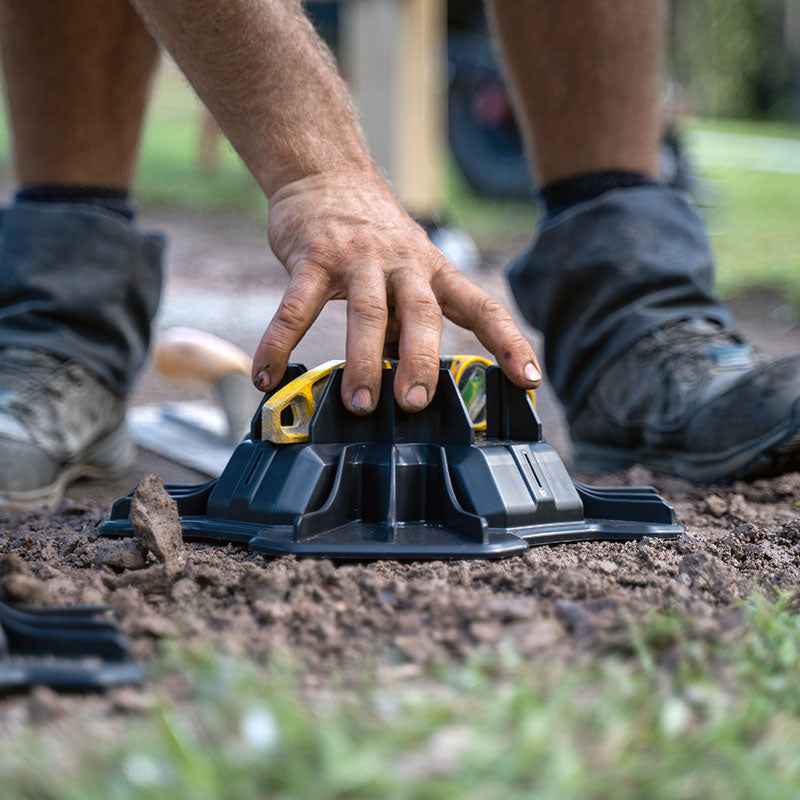
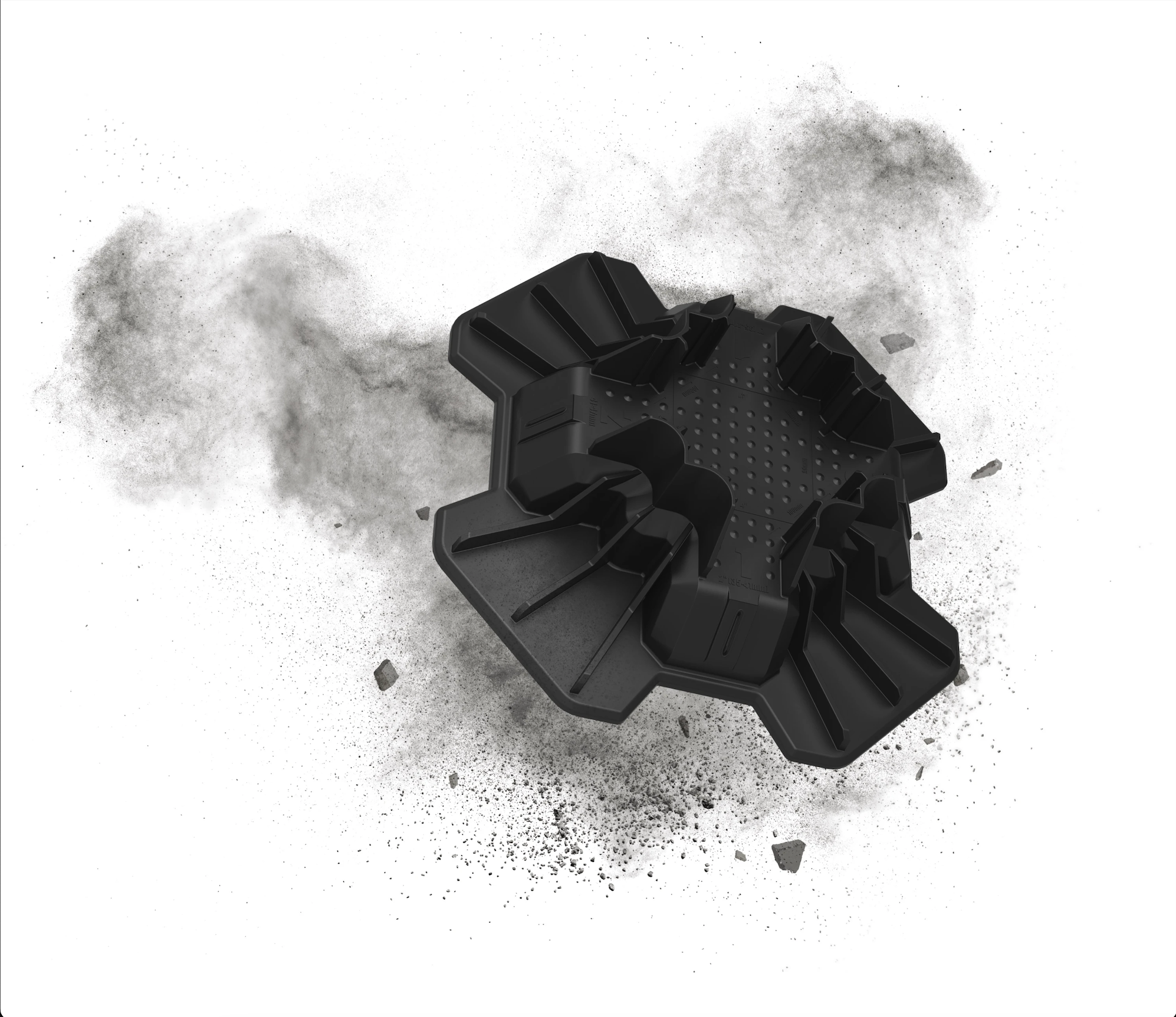
Deck blocks placed on a compacted gravel base at each support point. Your timber floor frame sits on top of the blocks, with 4x4 posts in the block saddles to adjust for any slope. This is the fastest, most adjustable, and most budget-friendly foundation method, and the one used by professional shed builders across North America.
Side-by-side Comparison
This is the comparison most builders are making when they start researching floating deck blocks. Here's how the two methods stack up on a standard 12' × 12' floating deck:
| FEATURE & BENEFITS | TuffBlock Deck Blocks | Concrete Slab | Concrete Deck Blocks | Gravel Pad |
|---|---|---|---|---|
| Digging required | No digging required | ✔ | ✘ | ✔ (excavation) |
| Concrete required | No concrete required | ✔ | ✘ | ✘ |
| Curing Time | No curing required | 3-7 days | ✘ | Compaction |
| Weight per unit | 1.5 lbs | N/A | 34-41 lbs | N/A |
| Adjustable on slope | ✔ (with posts) | ✘ | Limited | ✘ |
| Adjustable after build | ✔ | ✘ | ✘ | ✘ |
| Permit required | Often Not | Usually Yes | Often Not | Often Not |
| Relocatable | ✔ | ✘ | Partially | ✘ |
| Cost (relative) | Low | High | Low-Medium | Low-Medium |
| Warranty | 25 years | ✘ | ✘ | ✘ |
| Certified load rating | 1,700 lbs/block | N/A | Unverified | N/ |
Why Deck Blocks Work So Well for Sheds
Sheds are arguably the perfect application for the floating foundation system. Here is why:
Most sheds do not require a fixed foundation. Unlike a deck attached to your home, a shed is a freestanding structure. In most jurisdictions, freestanding sheds under a certain size do not require a permanent foundation, which means deck blocks are fully compliant and exactly what the job calls for.
Deck blocks keep timber off the soil. When a shed floor sits directly on or near soil, moisture wicks into the timber and creates ideal conditions for rot and termite activity. TuffBlock raises the floor frame off the ground, allows airflow beneath the structure, and keeps the timber dry. Combined with pressure-treated lumber, this dramatically extends the life of the shed floor.
Speed matters on shed builds. Professional shed builders who use TuffBlock on 100+ sheds per year consistently report cutting foundation install time by 50% or more compared to concrete blocks. The method is fast to learn, easy to train employees on, and eliminates the unpredictability of working with concrete on site.
See how Shedscape and Site Built are using TuffBlock on their builds, and what it's done for their install times.
Adjustability on sloped yards. Most residential yards are not flat. The combination of TuffBlock plus adjustable 4x4 posts means you can level a shed foundation on a yard with a 12-18 inch slope or more — something concrete blocks simply cannot handle cleanly. Because most freestanding sheds don't require a permanent foundation by code, you're not paying for or waiting on concrete you don't need. Deck blocks are fully compliant for the vast majority of residential shed builds, which means lower material costs, no curing delays, and a foundation you can adjust or relocate if your plans ever change.
Relocatable if needed. Because the foundation is not fixed, a shed on TuffBlocks can be dismantled and moved if your plans change, if you are renting, or if the structure needs to sit on a utility easement that must remain accessible.
What Size Sheds Suit a Deck Block Foundation?
TuffBlock is engineered for structures up to 36 inches above ground and suits the vast majority of residential shed sizes. As a practical guide:
Ideal for TuffBlock foundations:
- Storage sheds from 6ft x 8ft up to 16ft x 24ft
- Garden studios and she-sheds
- Workshops up to medium size
- Cubby houses and playhouses
- Dog kennels and animal shelters
- Bike and equipment stores
Where to consider alternatives or a hybrid approach:
- Very large workshops over 20ft x 30ft with heavy machinery (consider concrete slab)
- Multi-storey structures
- Sheds in areas with extreme soil instability or persistent flooding
- Any structure where local code specifically requires a permanent foundation
If your shed falls into the hybrid category, TuffBlock can be used in a composite foundation method, combining deck blocks with one or more in-ground concrete footings at key structural points. This gives you speed and adjustability where the structure allows, with permanent anchoring where code requires it.
How Many Deck Blocks Do You Need for a Shed?
Shed foundation block counts are generally lower than an equivalent-sized deck because sheds use the bearer method, bearers run across the short dimension of the shed, supported by TuffBlocks at intervals, with floor joists sitting on top of the bearers. This is more structurally efficient than supporting every joist directly.
Standard bearer method layout:
- Bearers run across the short dimension of the shed
- Bearers are supported by TuffBlocks at each end plus intermediate points, maximum approximately 5ft between blocks along each bearer
- Floor joists run perpendicular across the bearers at 16-inch on-centre spacing
Common Shed Sizes: TuffBlock Estimates
How many do you need?
The number of blocks you need depends on your deck size, lumber dimensions, joist spacing, and whether you're using a bearer system. The same 10ft × 20ft deck can require anywhere from 12 to 54 TuffBlocks depending on configuration.
| Shed Size | Square Feet | 16-20 blocks | Estimated TuffBlocks | TuffBlock Packs Required |
|---|---|---|---|---|
| 6ft x 8ft | 48 | 2 | 6 blocks | 8-Pack |
| 8ft x 10ft | 80 | 2 | 6 blocks | 8-Pack |
| 10ft x 12ft | 120 | 3 | 9-12 blocks | 8-Pack x 2 |
| 12ft x 16ft | 192 | 3 | 12 blocks | 8-Pack x 2 |
| 14ft x 20ft | 280 | 4 | 12-16 blocks | 24-Pack |
| 16ft x 24ft | 384 | 4 | 16-20 blocks | 24-Pack |
For your exact number, use our TuffBlock Deck Calculator.
Or read our full spacing guide: How Many Deck Blocks Do You Need?
How to Build a Shed Foundation with Deck Blocks
Here is the full process from start to finish. For a detailed step-by-step with real job site photos from a professional shed builder, watch the full youtube here.

Step 1: Plan Your Layout and Check Setbacks
Confirm your local setback requirements before placing anything. Most jurisdictions require a shed to sit at least 3-5 feet from property lines, some require 10 feet or more. Mark the four corners of your shed footprint with stakes and run string lines between them. Check square by measuring both diagonals, they must match.

Step 2: Mark Your Bearer Lines and Block Positions
Based on your shed size, mark where bearers will run across the short dimension. For most sheds up to 12ft wide, three bearers work well — one at each end and one at the centre. For wider sheds, add bearers so no bearer span exceeds 5ft. At each bearer line, mark individual TuffBlock positions at each end and at intermediate points.

Step 3: Prepare the Ground at Each Block Position
At every marked block position: remove grass and vegetation, compact the soil firmly, add 2-4 inches of compacted gravel (road base or crusher dust), level and compact again. This gravel base is critical, it provides drainage and gives you a fine-tunable surface for levelling each block. Do not skip it, even on apparently flat ground.

Step 4: Place and Level Your TuffBlocks
Set a TuffBlock on the prepared gravel at each position. Check level in both directions. Adjust gravel depth beneath the block until it sits perfectly level. On sloping ground, start at the highest point of your yard, this block will have the shortest post above it. Work outward from this point.

Step 5: Install Bearers with 4x4 Post Extensions
Cut 4x4 pressure-treated posts to the correct height at each block position. On flat ground, posts may be very short or not needed at all. On sloped ground, downhill posts will be progressively taller. Drop each post into the TuffBlock saddle, sit the bearer on top, and secure with lag screws, typically 5/16 inch x 4 inch exterior grade. Check level across the full bearer length before fixing.

Step 6: Install Floor Joists and Check Square
Install floor joists perpendicular across the bearers at 16-inch on-centre. Before fixing the subfloor, re-check square by measuring both diagonals of the full frame as both must match. If they are off, shift the frame slightly and re-measure before proceeding.

Step 7: Install Subfloor and Anchor if Required
Fix subfloor sheeting across the joists using a weather-resistant product. Advantech or equivalent is recommended over standard plywood for shed applications. If local code requires shed anchors or you are in a high-wind area, install earth anchors at the corners before the shed walls go up.
Shed Foundation on Sloping Ground
With TuffBlock, slope is handled by adjusting the 4x4 post height at each block rather than trying to level the blocks themselves. The blocks sit on the ground wherever they need to. The posts above them do the levelling work:
- A 6-inch slope across a 10ft shed width needs posts varying by 6 inches from one side to the other — straightforward to measure and cut
- A 12-18 inch slope is equally manageable, just with taller posts on the low side
- The blocks themselves never need to be shimmed, stacked, or adjusted, only the post heights change
Do You Need a Permit for a Floating Deck?
Permit requirements vary by state, county, and municipality. There is no single national rule, but some patterns apply across most US jurisdictions:
Permits are often NOT required for a floating deck when it:
- Is under a certain square footage (commonly 100-200 sq ft, but varies, sometimes as low as 10 sq ft)
- Is freestanding and not attached to the home
- Is not on a permanent foundation, floating foundations like TuffBlock often qualify as non-permanent
- Does not include electrical, plumbing, or gas
Permits ARE typically required when the shed:
- Exceeds your local size threshold
- Includes electrical or plumbing
- Is in a regulated zone (flood, wildfire, HOA area)
- Is on a property where the HOA requires separate approval
The floating nature of a TuffBlock shed base can work in your favour in many jurisdictions, a structure on a non-permanent foundation is treated more leniently than one on a fixed concrete slab.
When permits are required, TuffBlock is ICC-ES certified and compliant with the 2021 and 2018 International Building Code and International Residential Code. The TuffBlock Specification Guide and Compliance and Testing Report are available to download and present to your inspector.
Always check with your local building department before starting any deck project.
Deck Blocks for Sheds in Cold Climates
The most common concern about deck block shed foundations in cold climates is freeze-thaw performance and it is largely based on a misunderstanding of how the floating foundation system actually works.
The floating foundation system was specifically developed for cold climates. It was designed for ground that freezes hard in winter and expands unpredictably in spring, exactly the conditions where in-ground concrete footings cause the most problems.
When concrete footings are subjected to repeated freeze-thaw cycles, the ground expands and contracts around them unevenly. This stress transfers directly to the structure, causing heaving, cracking, and distortion over time. A floating foundation moves with the ground rather than resisting it, which dramatically reduces this stress transfer.
For cold climate shed foundations, the key is the gravel base:
- Install TuffBlocks on 4-6 inches of compacted gravel, not directly on soil
- The gravel improves drainage so water does not pool and freeze beneath each block
- Ensure good drainage around the full shed perimeter so water moves away from the foundation
TuffBlock shed foundations perform reliably across Minnesota, Michigan, Wisconsin, the Dakotas, and throughout Canad, among the most demanding freeze-thaw climates in North America.
To understand more about how frost heave occurs and why TuffBlocks provides the ultimate foundation solution for deck and shed building, read more about it here.


The fastest shed foundation you'll ever build.
No digging. No concrete. No curing time. Place your blocks, build your frame, done.
⭐️⭐️⭐️⭐️⭐️ Based on 500+ reviews
Shop NowRead more...
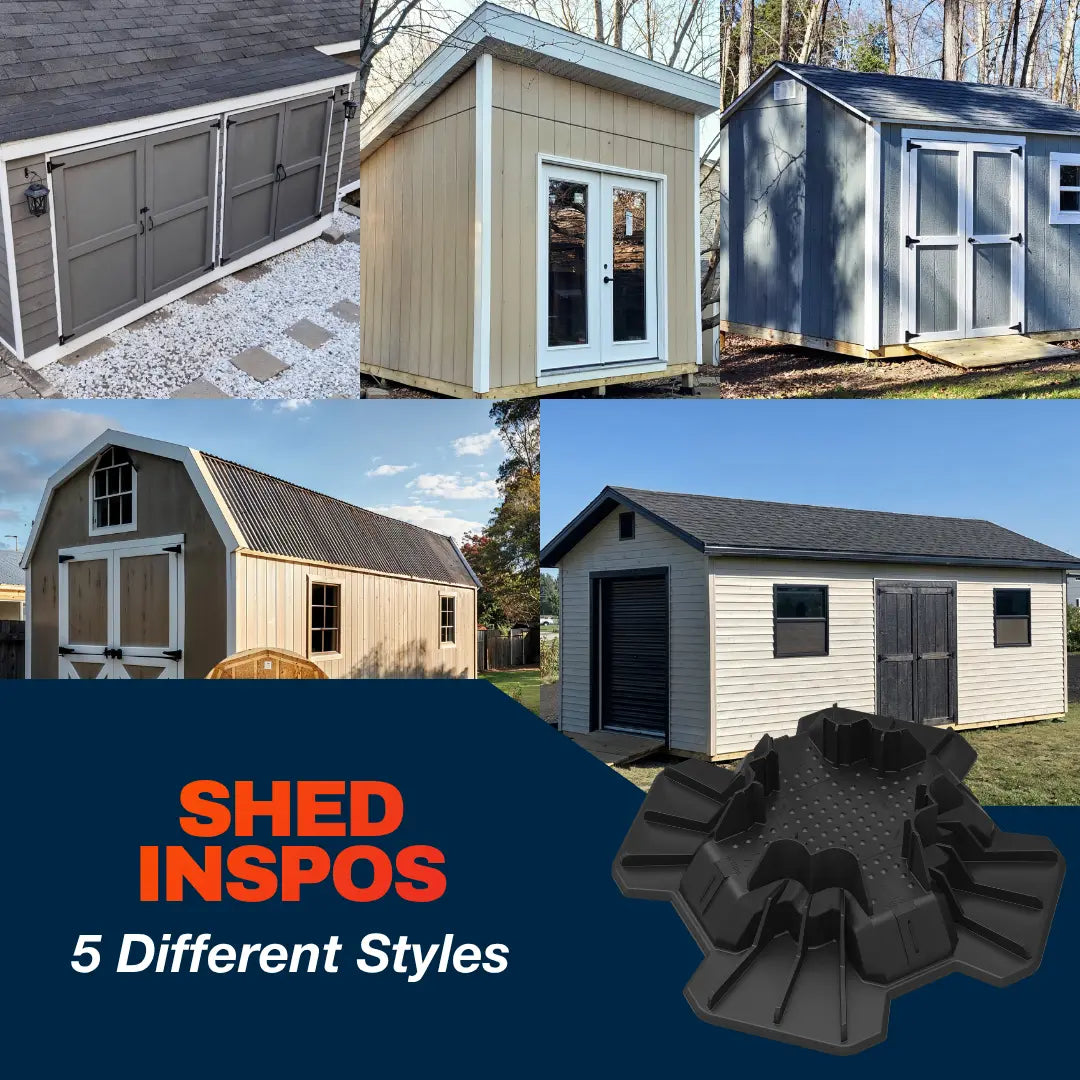
5 Shed Design Ideas That Actually Work for Any Backyard
From classic gable sheds to backyard studio offices — 5 shed design ideas with practical tips on layouts, features, and the right foundation for each style.
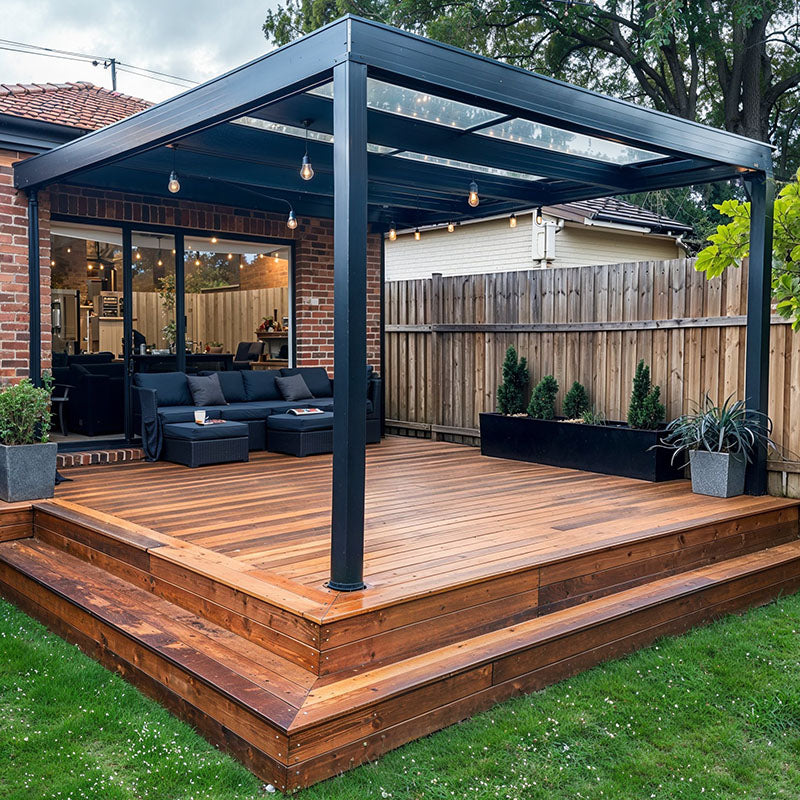
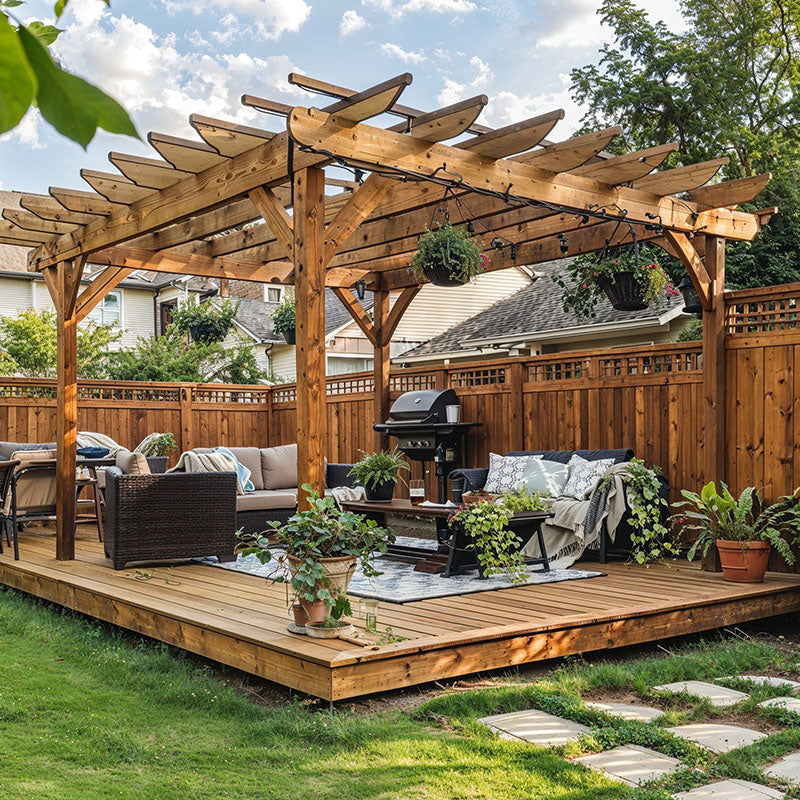
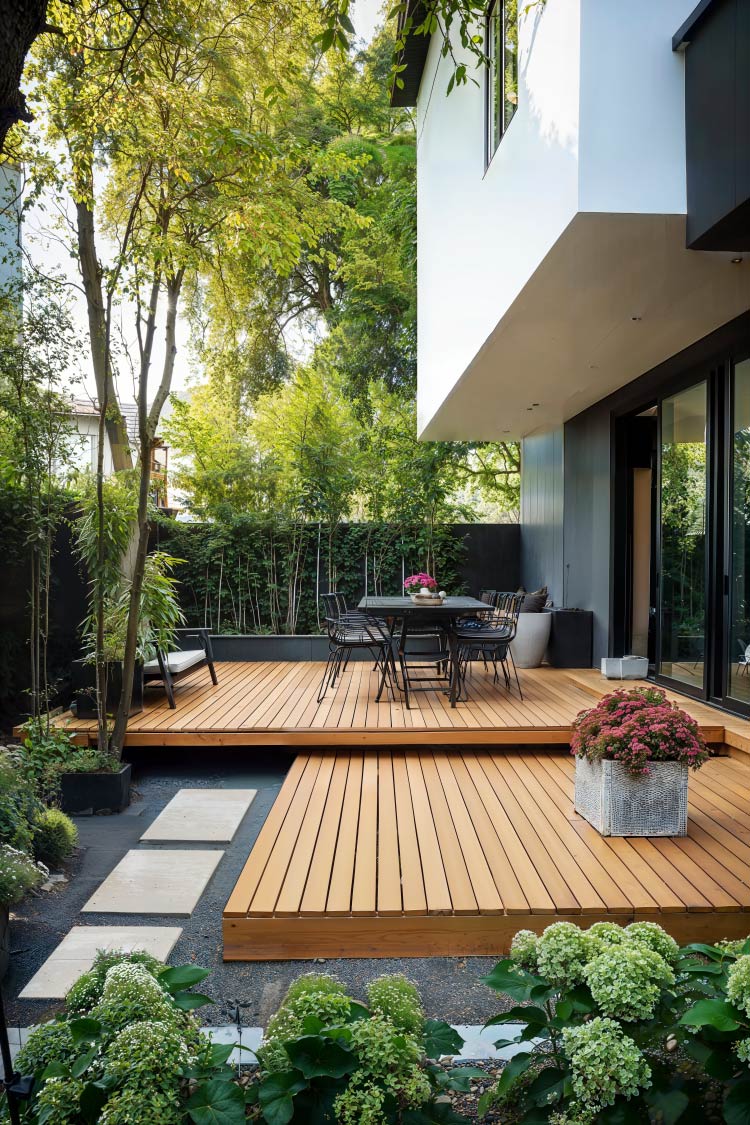
Can I Use Deck Pier Blocks Instead of Footings?
A deck pier block is in many ways just a simplified version of a “precast foundation”, a foundation type recognised by building codes.

Ready to Build?
TuffBlock is available online with free shipping across the USA, and in-store at Lowe's nationwide.
ICC Certified
150K+ Real Builds
Rated 4.9/5 stars
25 year warranty
made in USA
Always check your local building code requirements before starting any deck project. TuffBlock is ICC-ES certified and compliant with the 2021 & 2018 IBC and IRC. Compliance may vary by local jurisdiction.