




How Many Deck Blocks Do You Need?
The number of TuffBlocks you need depends on five things: your deck dimensions, lumber size, joist spacing, joist direction, and whether you’re using bearers. The same 10ft × 20ft deck can require anywhere from 12 to 54 TuffBlocks depending on how it’s configured — the five illustrated examples below show exactly why, and how to calculate your own number before you order.
→ Know your dimensions? Jump straight to the TuffBlock Deck Calculator
If you’re using deck blocks then an important first step when creating your list of materials is to work out exactly how many you need for your project.

Before we delve into any specifics, let’s first cover the main factors that affect our calculations:
- What are the dimensions of your project?
- What size lumber are you using?
- What are your joist centres?
- Which direction are your cross joists?
- Is your project raised or is it a ground level deck?
1. The dimensions of your project
This one is pretty self-explanatory, but some decks may have multiple corners or curved edges which affects the number of deck blocks required.
2. What size lumber are you using?
The size of lumber will determine what your spans will be. The thicker your lumber, the further apart your span supports can be. It’s generally recommended that 2x6 or thicker be used for a sturdy deck. Check your local span tables to find out what is required by code.
3. What are your joist centres?
The spacing of the joists will depend on the type and thickness of the deck board material you are using, as well as the design and load requirements of the deck. In general, joists for a deck should be spaced 16 inches on center for rectangular decks and 12 inches on center for diagonal decks. However, it is always best to consult the specific installation instructions for the decking material you are using to ensure that the joists are spaced correctly.
In general, composite boards require closer joist centres (to remove ‘bounce’), whereas hardwood boards can be further apart.
Additionally, local building codes may have specific requirements for the spacing of deck joists, so it is important to check with your local building department to ensure that your deck is built in compliance with all applicable codes.
4. Which direction are your cross joists?
As you’ll see in examples below, the direction of your cross joists can have a significant impact on the number of deck blocks you’ll require. For example, with a 10ft x 20ft deck, the number of supports can vary from 32 to 54 depending on whether the joists are along the 20ft length or the 10 ft length.
5. Is your project raised or is it a ground level deck?
If you’re building a raised deck with a layer of bearers beneath your joists then you’ll require fewer deck blocks. For a visual explanation of this, check out our 3D explainer video showing this in action:
https://www.youtube.com/watch?v=oT9bLQWw5vw&t=110s
A ground level deck is often the preferred choice for floating decks because it removes the step up and allows you to walk straight onto it much like a patio or walkway. If you do build a raised deck, then it cuts the number of deck blocks needed by roughly 40-60%.
Lastly let’s cover span tables in more detail.
Span tables for lumber are tables that provide information on the maximum allowable span of lumber for a given size, species, and grade of lumber when used in various types of construction. Span tables are used by builders and contractors to determine the size and spacing of the lumber members required to support a given load. The tables take into account the strength and stiffness of the lumber, as well as other factors such as moisture content, type of load, and duration of the load. Span tables are typically provided by lumber manufacturers and can also be found in building codes and design guides.
Span tables also gives us an indication of allowed overhang for our joists. An overhang isn’t required, but it’s useful to hide the TuffBlocks under the deck. A typical allowed overhang is ¼ to 1/3 of your span table for the lumber you’re using. It’s always best to check your local building codes to see what is allowed in your area.
Now that we’ve covered off the main factors, let’s dive into some practical examples.
Example 01: A 10ft x 20ft ground level deck using composite decking boards & 2x6 treated southern pine joists
In this example our cross joists will be along the 20ft length.


There are many different materials that can be used for decking boards, including wood, composite materials, and plastic. Wood decking boards are commonly made from lumber species such as cedar, redwood, or pressure-treated pine. Composite decking boards are made from a mixture of wood fibers and plastic, and are a popular alternative to wood because they are more durable and require less maintenance.
They do tend to have more flex than cedar or redwood, so the joist centres need to be closer together (14 inches in this case) to remove any ‘bounce’ from the deck and to make sure it’s firm under foot.
Check with the supplier as they will be able to guide you on the appropriate joist centres for your specific deck boards.
Therefore, we’ll require 8 cross joists at 14 inch centres.
The allowable span for 2x6 southern pine is 9 feet. Although this is the ‘allowable’ span, in practice it’s much more common with a 2x6 to use a 5-6 foot span for a firm and durable deck without any bowing of the joists or sag over time.
Therefore, we’ll require 4 TuffBlocks per 20ft joist, spaced 6 foot apart with a 1 foot overhang on the ends.
Example 02
Now let’s change the direction of the cross joists, so they’re aligned with the 10ft length.


The direction of your cross joists is determined by the direction of the deck boards (which will be the opposite direction). Typically you want to face the deck boards parallel to the direction you’ll be walking onto the deck in order to have the most grip under foot. But this is also mostly to taste.
We require 18 cross joists at 14 inch centres.
Each cross joist requires 3 deck blocks.
Example 03
With 2x10 joists we could eliminate the middle supports, with only 2 TuffBlocks per cross joist:


This would raise the deck by 4 inches, but it would reduce the number of TuffBlocks down to 36 (18 x 2).
We’d definitely recommend a middle support in this instance for the longevity of your deck and to make sure it’s sturdy, but this is to illustrate that using thicker joists could impact the number of deck blocks you’d require.
Example 04
Let’s look at another example here but instead of composite boards, let’s use a hardwood deck board. We’ll also replace the 2x6 joists with 2x10s.


This deck has 7 cross joists at 16 inch centres.
And with the 2x10 joists, we have 8 foot spans with a 2 foot overhang on either side.
7 joists x 3 supports = 21 TuffBlocks.
Example 05
The final example demonstrates a raised deck (although hard to illustrate from a top down) that uses bearers beneath joists:
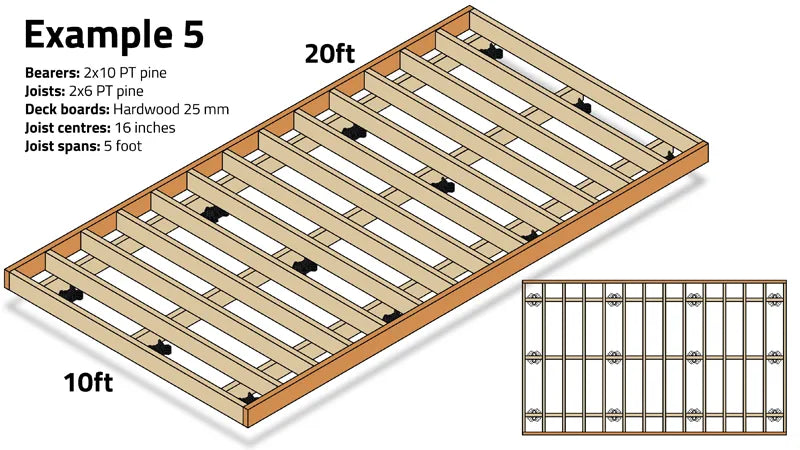

The bearers use 4 supports per bearer and are spaced (slightly under) 5 foot apart.
This allows the joists to be supported at 5 foot spans.
The joists are spaced 16 inches apart, on which the decking boards will be placed.
So for our calculations:
3 bearers x 4 supports = 12 TuffBlocks.
By using a row of bearers beneath our joists, we reduce the number of TuffBlocks required from 32 down to 12.
Conclusion
With these 5 examples, we can see how a number of factors can affect the number of deck blocks our floating deck requires:
Please bear in mind that you will need to build in line with your local codes that govern span tables and joist centres for the lumber that you’re using.
Additionally, some builders like to use more supports to ensure the strength, sturdyness and longevity of their deck. The more deck blocks used along the spans, the firmer the deck will feel.
Likewise, the closer the joist centres, the firmer the deck boards will feel under foot.
Common Deck Size Quick Reference
Not sure where to start? Here are estimated TuffBlock counts for common deck sizes at standard 16″ on-centre joist spacing:
Estimates based on standard 16″ joist centres. Your actual count may vary based on lumber size, board type, and layout. Always use the TuffBlock Calculator for your specific project.
→ Use the TuffBlock Deck Calculator for your exact estimate
Ideal for small sheds, landings, stairs, and compact decks.
Ideal for most floating deck and shed foundation projects.
FAQ
What is the maximum recommended TuffBlock spacing along a joist?
As a practical guide, 5ft is the most common maximum span used in real-world builds with standard residential lumber. Your actual maximum depends on your lumber species, size, and grade — always refer to your local span tables to confirm what’s permitted for your specific materials.
Does joist direction really make that much difference to block count?
Yes — as Examples 1 and 2 show, rotating joist direction on the same 10ft × 20ft deck changes the count from 32 to 54. It’s one of the highest-impact decisions in your material planning, and one of the easiest to overlook. Sketch your layout before you order.
Can I use the bearer system on a ground-level deck?
Yes. The bearer method isn’t exclusive to raised decks. On a ground-level build, adding bearers will raise the finished deck height slightly — by the depth of the bearer lumber — but it’s a perfectly valid approach if reducing your block count is a priority.
What’s the right number of TuffBlocks for a shed base?
A shed base typically suits the bearer method well. Run bearers across the short dimension of the shed at roughly 5ft intervals, each supported by TuffBlocks. A 10ft × 12ft shed base typically needs 9–12 TuffBlocks depending on bearer layout. See our shed foundation guide for full details.
Does TuffBlock spacing change in cold or freeze-thaw climates?
No — spacing is determined by structural load, not climate. In freeze-thaw regions, TuffBlocks are placed on a compacted gravel base rather than directly on soil to improve drainage and manage frost heave risk. Spacing rules remain the same. See our frost heave and floating foundations guide for more detail.
Can I add more TuffBlocks after the deck is already built?
Yes — this is one of the practical advantages of the floating foundation system. If your deck develops any flex over time, you can jack the frame at any point and slide additional blocks into position without disturbing the rest of the structure.
What if my deck has an irregular shape?
Each change in frame direction — corners, notches, steps — needs its own TuffBlock support at that point. Add these to your base count from the joist layout. For complex shapes, sketch your frame to scale and count each individual support point before ordering.
Still not sure? Use the calculator.
Enter your deck dimensions and joist size — the calculator gives you the exact block count and spacing layout.
Calculate how many TuffBlocks you need →BuildTuff offers this content as a general guide only. Always refer to your local building codes and span tables for the specific lumber species, grade, and construction requirements applicable to your project.